




Insolvency Statistics Q4 2022


The Insolvency Service has recently published statistics for the fourth quarter of 2022. Creditors’ voluntary liquidations (CVLs) were the most common company insolvency procedure (85% of cases), followed by compulsory liquidations (9% of cases), administrations (6% of cases) and company voluntary arrangements (CVAs; 1% of cases).
Historically, changes in company liquidation rates have been related to economic conditions. In periods of economic growth, liquidation rates tend to decrease. During and shortly after recessions, the liquidation rate tends to increase. However, the recent recession coinciding with the coronavirus pandemic did not follow this pattern, with the liquidation rate decreasing during 2020. This is likely partly due to the Government measures taken to support business. For example, it guaranteed loans such as Bounce back loans and CBILs to help maintain the working capital of businesses. The Government also contributed to the wages of furloughed employees between 1 March 2020 and 30 September 2021 through the Coronavirus Job Retention Scheme. This support has now been phased out.
Following this, the country was then hit by high energy costs as a result of the war in Ukraine, which has led to high inflation and interest rates. It is only now that the number of insolvencies has surged.
Interestingly, the five industries that experienced the highest number of insolvencies in 2022 were:
- Construction (4,143, 19% of cases with industry captured)
- Wholesale and retail trade; repair of motor vehicles and motorcycles (3,263, 15% of cases with industry captured)
- Accommodation and food service activities (2,704, 12% of cases with industry captured)
- Administrative and support service activities (2,212, 10% of cases with industry captured)
- Professional, scientific and technical activities (1,799, 8% of cases with industry captured)
Registered company insolvencies in 2022 were the highest since 2009, driven by a historically high number of CVLs and an increase in compulsory liquidations.
England and Wales, 2002 to 2022
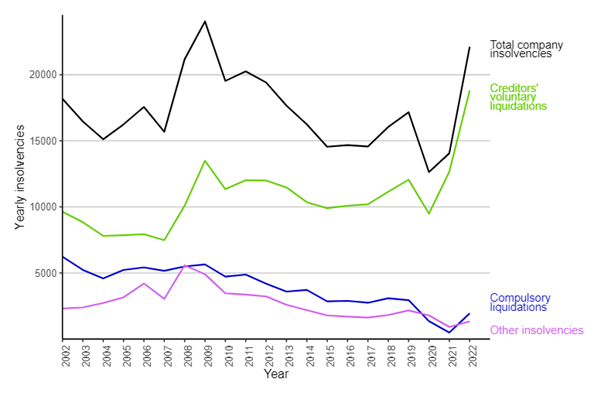
It is worth pointing out that the number of Compulsory liquidations is steeply rising. This is due largely because of the more aggressive stance that HMRC is taking in chasing outstanding debts now that the provisions of the Corporate Insolvency and Governance Act 2020 - which suspended the serving of statutory demands between 1 March 2020 and 30 September 2021, and restricted winding-up petitions where unpaid debt was due to COVID-19 - no longer apply.
Probably the only insolvency process to decline is Company Voluntary Arrangements. It is thought that this again is due to HMRC. Since the end of 2020, HMRC is classed as a secondary preferential creditor in relation to certain types of taxes. These include the taxes collected by a business on their behalf, such as PAYE and VAT. HMRC remain an unsecured creditor for corporation tax and any other taxes owed directly by a company. Because HMRC has risen in the pecking order in getting a distribution in a CVA, the amount available to floating and unsecured creditors has considerably reduced, therefore there is no incentive for these creditors to vote in favour of an arrangement that may have helped the survival of an ailing business.

Subscribe to
Inspired
Our monthly bulletin INSPIRED is packed with useful articles to keep you up to date with news and legislation that may affect you or your business.


Armstrong Watson can help
Whether you need expert accounting, strategic business advisory, tax planning, or financial guidance, our experienced team is here to support your success. From sole traders to large enterprises, we provide tailored solutions to help you navigate complex financial challenges and achieve your goals. Get in touch today to discover how we can help your business thrive – call 0808 144 5575.


