




An interview with … Frank Maher, Solicitor and Partner at Keystone Law
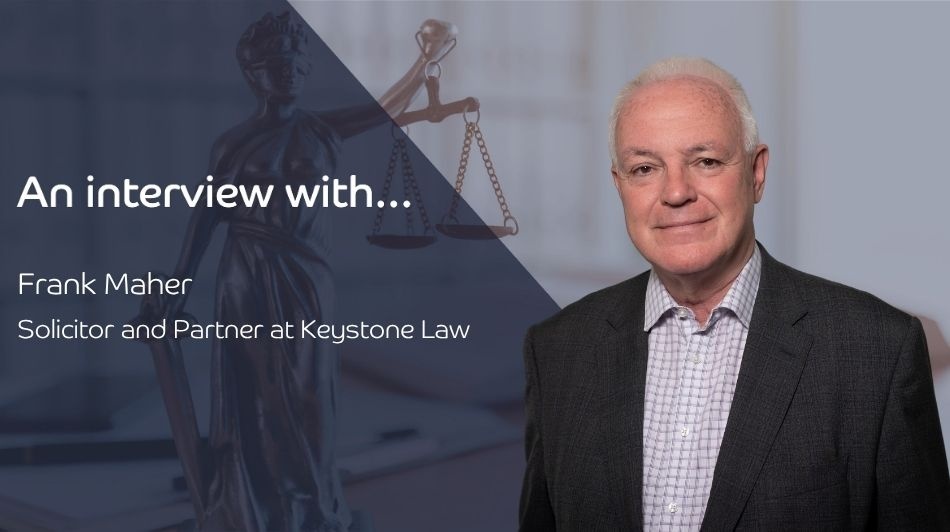
Frank Maher is a specialist solicitor advising law firms on professional regulation and compliance and professional indemnity insurance. He spoke to Andy Poole about the change to Financial Conduct Authority supervision of law firms for anti-money laundering, and what steps firms should be taking now.
1. What’s the move to FCA regulation for anti-money laundering about?
The Financial Conduct Authority (FCA) will become the supervisory body for law firm anti-money laundering (AML) regulation in place of the Solicitors Regulation Authority (SRA) and other professional body supervisors including the Council for Licensed Conveyancers and accountancy bodies.
The aim is more centralised and standardised supervision. But the SRA will maintain its role for all other areas of regulation and compliance. The intention is that the FCA will issue new guidance but will draw on the professional bodies to help draft it.
We can expect a more interventionist approach to AML regulation: the Office for Professional Body AML Supervision (OPBAS) has been critical of levels of enforcement by the professional bodies and failure to impose penalties that deter non-compliance.
The Government’s response to the recent consultation dismissed concerns about how dual regulation will work. But, to take one example, who will deal with a breach of the SRA Accounts Rules prohibition on providing a banking facility which may create a risk of money laundering - the SRA or the FCA?
The Government has confirmed that the FCA will not be able to access legally privileged documents, but the FCA has form for challenging privilege and firms could have to shoulder the burden of expensive litigation determining whether privilege applies.
There is also the risk that a firm in breach may be ordered to obtain and pay for a skilled person review under section 166 of the Financial Services and Markets Act 2000.
2. When is it going to happen?
The Government’s aim is for the reforms to be implemented by late 2028. The Financial Services and Markets Bill, which is going through Parliament at present, provides for the Government to make regulations to bring this about.
That may seem a long way off, but I think the time to start preparing is now. In particular, a stricter regime will apply for authorisation applying the FCA’s ‘fit and proper’ test to approval for Beneficial Owners, Officers and Managers (BOOMs).
3. What will law firms need to do?
There are no indications from the FCA yet on what the application for authorisation will involve, but a few clues as to possible requirements may be found in the FCA’s recently published information about the authorisation application form for cryptoasset firms, which is intended for planning purposes only.
This contains a draft application which covers basic details, such as the firm’s legal status and organisational structure, what work it does, types of clients, how you will manage risks specific to your firm, and financial crime prevention framework.
It asks about controllers of the firm and requires an organisational structure chart. It also requires details of fees and uploading of financial forecasts. Not surprisingly, it asks about the firm’s regulatory history and solvency events. The firm will also have to upload its Practice Wide Risk Assessment (PWRA) and Policies Controls and Procedures (PCPs), a compliance monitoring plan and a records management policy and procedures. Information is required on tools used for client due diligence.
Clearly firms need to think about these and ensure particularly that their PWRA and PCPs are up to date, compliant and show version control. I would expect some information to be required on training too, with records, and demonstrating that it is tailored to the firm’s work and clients, not just a biannual generic video.
4. What about firms which have been fined by the SRA?
This will be a worry for the few hundred firms which have been fined by the SRA even though, surprisingly, there is no record of the FCA fining any businesses such as insurance brokers or financial advisers for AML breaches, though there have been a handful of high-profile cases involving financial institutions. They should start thinking now about how to address this and demonstrate that they now ensure compliance. They may need to go the extra mile to do so.
5. Have you any tips to prepare for it?
Although some smaller firms are not required to have an audit under regulation 21 of The Money Laundering, Terrorist Financing and Transfer of Funds (Information on the Payer) Regulations 2017, it is worth them considering this too. It may save a lot of stress further down the line.
The FCA will only be supervising work which is in the regulated sector under the MLR. On the face of it, litigation or personal injury, for example, are generally outside the regulated sector.
However, even those areas can cross into the regulated sector for AML purposes if they involve tax advice – should damages be claimed gross or net of tax, or are damages subject to VAT? Immigration and employment can also be within the net for AML compliance depending on the circumstances. Many tax issues can arise in employment law in particular, not just whether a settlement is below the £30,000 threshold, but, for example, payment for restrictive covenants, damages for breach of contract and tax-exempt pension schemes.
These need to be considered matter-by-matter, but if firms have the data which enables them to confidently separate matters of this nature where there is tax advice from those where there is not, they may be able reduce the extent to which their caseload is subject to FCA supervision. That may involve different work type codes on matter opening, flags for tax advice triggers, and monitoring for change of scope.
In summary, the time to start thinking about FCA supervision of your firm’s AML compliance is now.
Frank Maher advises a wide cross-section of law firms, from US-and UK-based international practices to regional and high street firms. His practice covers regulation, compliance including anti-money laundering, conflicts and privilege. He also advises firms on insurance coverage, including block notifications and successor practice issues. For more information, please visit www.keystonelaw.co.uk.

Subscribe to
Inspired
Our monthly bulletin INSPIRED is packed with useful articles to keep you up to date with news and legislation that may affect you or your business.


Related news stories


Armstrong Watson can help
Whether you need expert accounting, strategic business advisory, tax planning, or financial guidance, our experienced legal team is here to support your success. Get in touch today to discover how we can help your law firm thrive – call 0808 144 5575.


