




An interview with…Paul Bennett, Solicitor and Partner at legal sector specialist solicitors, Bennett Briegal LLP
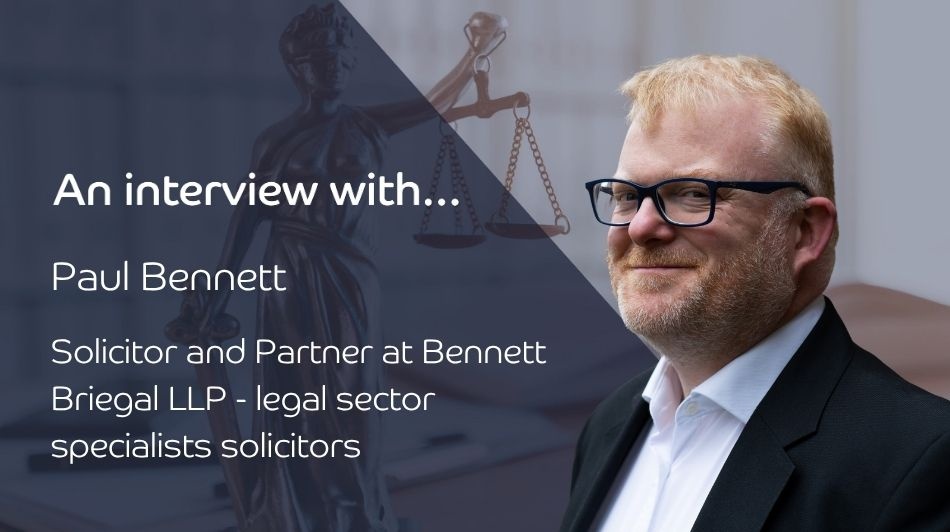
An interview with … Paul Bennett, Solicitor and Partner at legal sector specialist solicitors, Bennett Briegal LLP
Paul Bennett is a specialist solicitor advising law firms on partnership, professional discipline, and compliance. He spoke to Andy Poole about the regulatory landscape for law firms in 2026, the lessons from a landmark case on supervision, and why records may be a firm’s most important asset.
1. What are you seeing from the SRA in terms of investigations and focus areas in 2026?
The themes are well established. The SRA continues to investigate professional misconduct complaints, conduct AML audits, and carry out thematic reviews — and this is where I expect the sharpest focus this year. The SRA’s new CEO, Sarah Rapson, is on record as wanting to lead with supporting compliance, not enforcement, but both will be very common.
Two issues stand out. First, high-volume consumer claims are firmly back in the spotlight. Firms operating in that space should expect scrutiny. Second, the knowledge and practical discharge of duties by compliance officers — COLPs and COFAs — remains under review. The regulator is asking whether those appointed to such roles truly understand their obligations, or whether the appointments are more nominal than substantive.
On AML specifically, despite the Financial Conduct Authority's (FCA) forthcoming move to take on that aspect, the SRA remains the principal regulator for law firms for now. Firm-wide risk assessments, client and matter risk assessments, and source of wealth and source of funds checks remain live obligations — and live risks. Firms that treat these as box-ticking exercises tend to discover why that is a mistake with enforcement action damaging their reputations.
2. What would you want COLPs, COFAs, and General Counsel to focus on?
Three things, and they are interconnected.
First, records. I cannot overstate this. Records are the difference between a firm that can demonstrate what it did, why it did it, and how it managed the risks arising, and a firm that cannot. In my experience, disciplinary proceedings are frequently pursued or not based on the quality of the paper trail, not on the underlying conduct.
Second, training. The SRA Standards and Regulations 2019 came into force some years ago, but I still encounter significant gaps in understanding - particularly regarding effective supervision and conflicts of interest. Training on those topics is not a luxury; it is a basic compliance obligation. Without looking up the SRA Principles, are there 5, 7 or 10 of these? Now, list them? If you are unsure, you and your team cannot possibly apply them.
Third, culture. Compliance cannot sit with the COLP and COFA alone. Policies need to be embedded, supervisors need to reinforce the messages consistently, and risk awareness needs to be a firm-wide habit rather than an occasional reminder from the compliance team.
3. Supervision has been in the news following the Mazur judgment. What is the practical lesson for firms?
The Mazur case, decided in the High Court in September 2025, concerned the reserved legal activity of litigation. It has wider significance as a judgment on supervision. The Court of Appeal decision of CILEX’s challenge to it is awaited, but the supervision lessons need to be learned, irrespective of the appeal outcome. I acted as Counsel in Mazur. The central lesson is that supervision must demonstrate genuine oversight and control of risk - not merely the existence of a supervisory structure on paper.
The debate sparked by the judgement covers skills such as coaching, clear communication of standards, and an evidenced ability to identify and respond to problems. For Managing Partners and General Counsel, the question to ask is straightforward: if the SRA came in tomorrow and asked to see how supervision works in practice, could you show them? If the answer is no, that is where to start.
4. You are also seeing firms approach mergers and acquisitions — what is different from a risk perspective, now, compared to even a few years ago?
The main change flows directly from the Axiom Ince collapse and multiple failures of certain consolidators over the past decade. The SRA is challenging approaches to client confidentiality, merger risks, and client account management that would previously have gone unchallenged.
Insurers have moved in the same direction. Professional indemnity insurers have been burnt, and they are behaving accordingly — more sceptical, more cautious, and more likely to ask difficult questions.
5. What do you think are the most underrated challenges facing leaders of medium to large law firms?
Productivity - and specifically the failure to think seriously about how individuals and teams work most effectively. Law is a people business, and the most important asset in any firm is the focused, high-quality thinking of its lawyers. Yet many firms tolerate structures and habits that actively undermine thinking. We are paid to think and problem-solve.
Deep work - meaningful, uninterrupted focus on the most important task - is increasingly rare in an environment of constant notifications, open inboxes, and the expectation of instant responses. Habits that support effective working, whether that is protected time blocks, structured delegation, or disciplined use of technology, compound over time in the same way that poor habits do.
Good supervision and good productivity are connected. A well-supervised team, clear on its priorities, is productive. Leaders who treat those two things as separate problems miss the connection between them.
6. Finally, your one compliance tip for law firm leaders?
Keep records. Document what you did, when you did it, and why. Record how risks were identified and what was done about them. Record training given, supervision provided, and decisions made.
In my experience, firms that maintain thorough records are well-positioned to defend themselves effectively when investigated. Firms that do not, are not. It is as simple as that. Records are the shield to your firm's reputation.
Bennett Briegal LLP advises law firms on regulation, compliance, M&A, commercial contracts and law firm structures, . Paul supports General Counsel, COLPs, COFAs, and Managing Partners with internal investigations, self-reports to the SRA, and representation in the SRA and the Solicitors Disciplinary Tribunal disciplinary processes. He can be contacted at www.bennettbriegal.co.uk.

Subscribe to
The Law
The LAW is our online newsletter for the legal profession, produced by our legal sector team. It provides a platform to share our experience of supporting lawyers across the UK.


Related news stories


Recent news stories


Armstrong Watson can help
Whether you need expert accounting, strategic business advisory, tax planning, or financial guidance, our experienced team is here to support your success. From sole traders to large enterprises, we provide tailored solutions to help you navigate complex financial challenges and achieve your goals. Get in touch today to discover how we can help your business thrive – call 0808 144 5575.


